apjohndim.com

Author name: apostolopoulos.john.dim@gmail.com

New

Top 2% Update

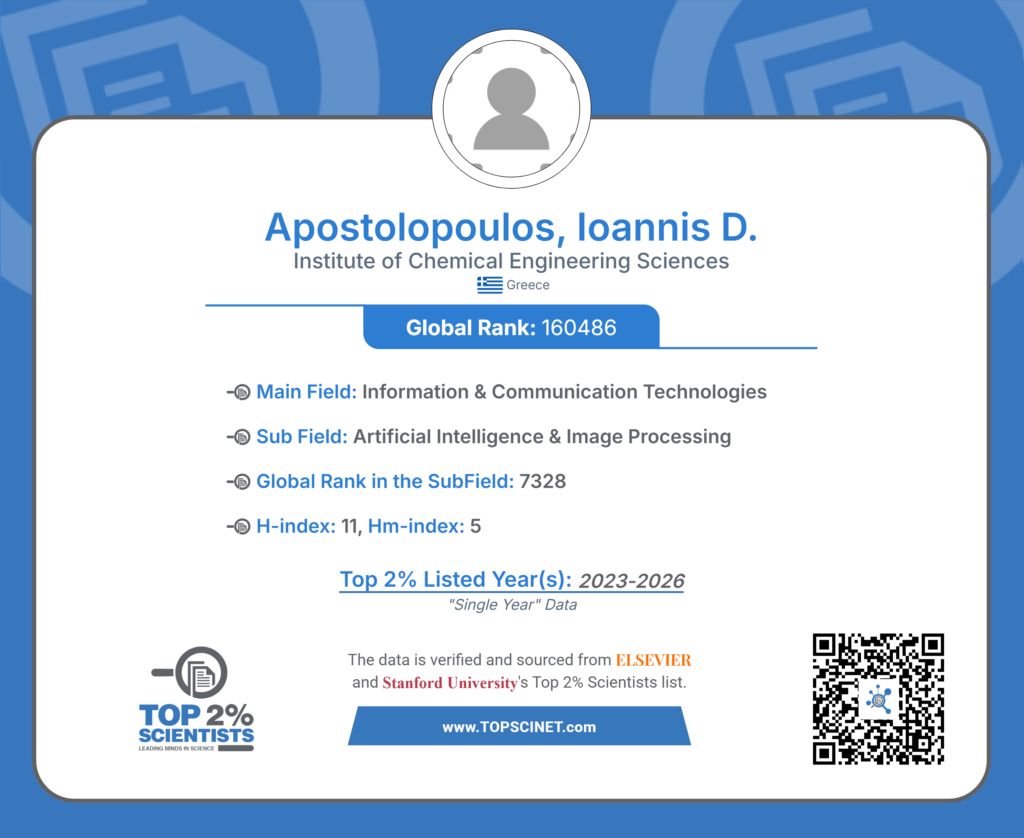
I was recently listed in the Top 2% Scientists ranking based on verified data from Elsevier and Stanford University for the years 2023-2026. The data reflects my ongoing work at the Institute of Chemical Engineering Sciences in Greece, focusing on Information & Communication Technologies, with a subfield in Artificial Intelligence & Image Processing. The metrics highlight a global subfield rank of 7,328 and an H-index of 11. While these numbers offer a quantitative look at my research output over the past few years, my priority remains the practical application and continuous, quiet progression of my work in AI.  
New

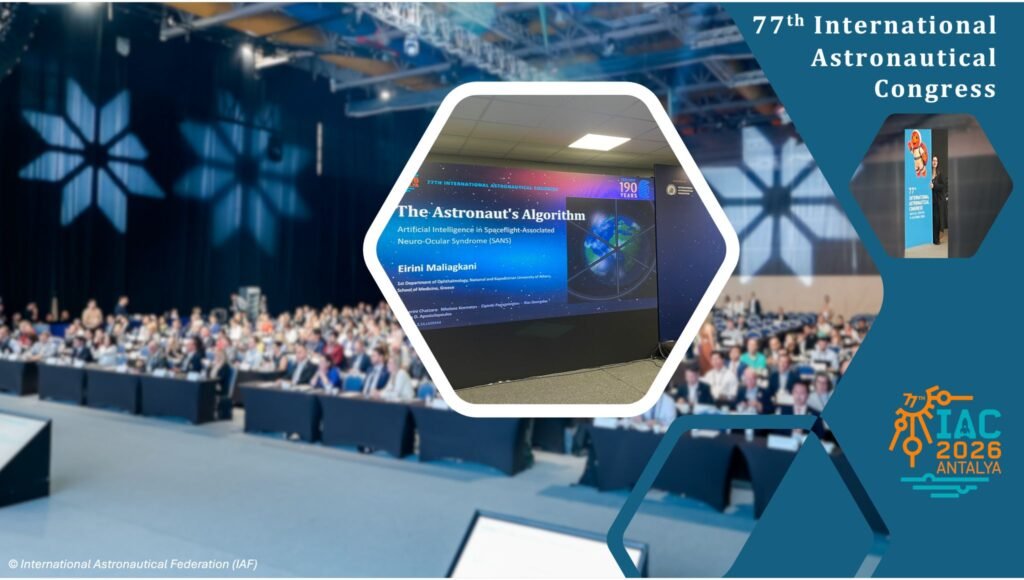
Showcasing AI in Space Medicine at IAC 2026

At the 77th International Astronautical Congress in Antalya, our team had the distinct honor of presenting our latest research, “The Astronaut’s Algorithm: Artificial Intelligence in Spaceflight-Associated Neuro-Ocular Syndrome (SANS).” Delivered as an oral presentation by Eirini Maliagkani and selected from over 8,300 global submissions, our work focuses on leveraging AI to tackle one of the primary health hurdles for astronauts on extended missions. As the senior author of this paper, I am immensely proud of the collaboration that made this possible. Connecting Greek ophthalmology and AI research with the broader aerospace community is a unique privilege, especially as we represent the 1st Department of Ophthalmology of the National and Kapodistrian University of Athens (NKUA) during its 190-year celebration. Congratulations to Eirini Maliagkani for a fantastic presentation, and a special thank you to my fellow co-authors Ilias Georgalas, Elpiniki Papageorgiou, Nick Kosmatos, and Aikaterini Chatzara for their dedication and expertise. 📸 © International Astronautical Federation (IAF)

New

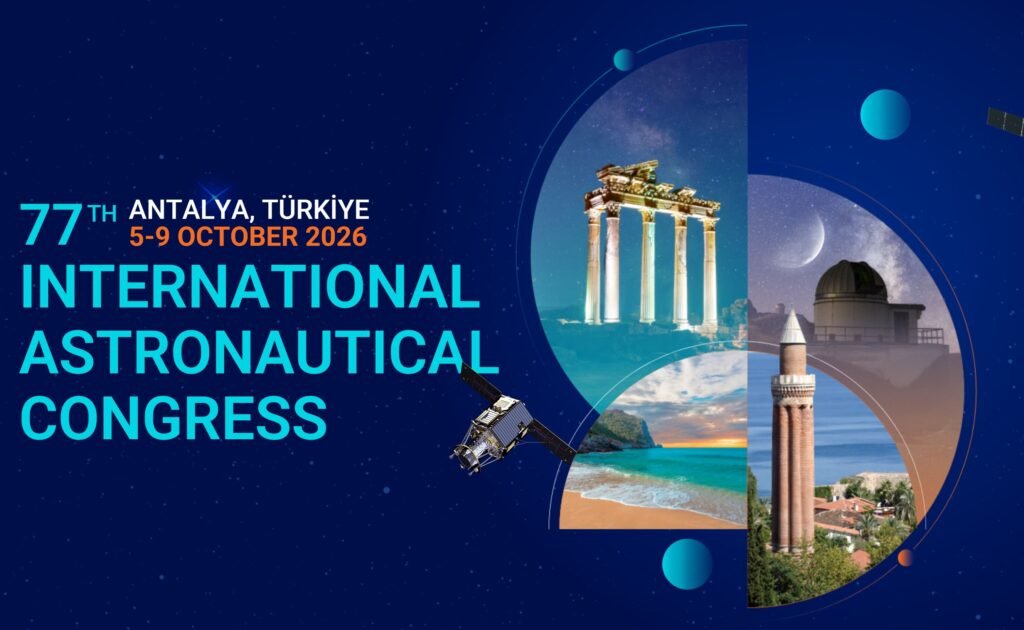
Our Conference Paper got accepted at the 77th International Astronautical Congress (IAC 2026), Antalya, Türkiye, 5-9 Oct 2026!

Spaceflight-associated neuro-ocular syndrome (SANS) is one of the most important medical challenges associated with long-duration spaceflight. This systematic review aimed to comprehensively evaluate artificial intelligence (AI) models developed for the detection, prediction, and monitoring of SANS, with particular emphasis on model development, validation, performance, and operational readiness. Conference Website

New

AIRGO Kicks Off!

AIRGO designs and builds AI systems for businesses, the public sector and research teams. Scientifically grounded, explainable, and wrapped in an interface the people who actually use it can understand. We do not just provide AI. We ground our AI models to your needs and your data and we deliver scientific-based AI-powered platforms, tools, solutions. Bring us the problem you want to solve. Together, we can turn your data and ideas into something your team can use every day.

Press

Άρθρο της εφημερίδας Πελοπόννησος

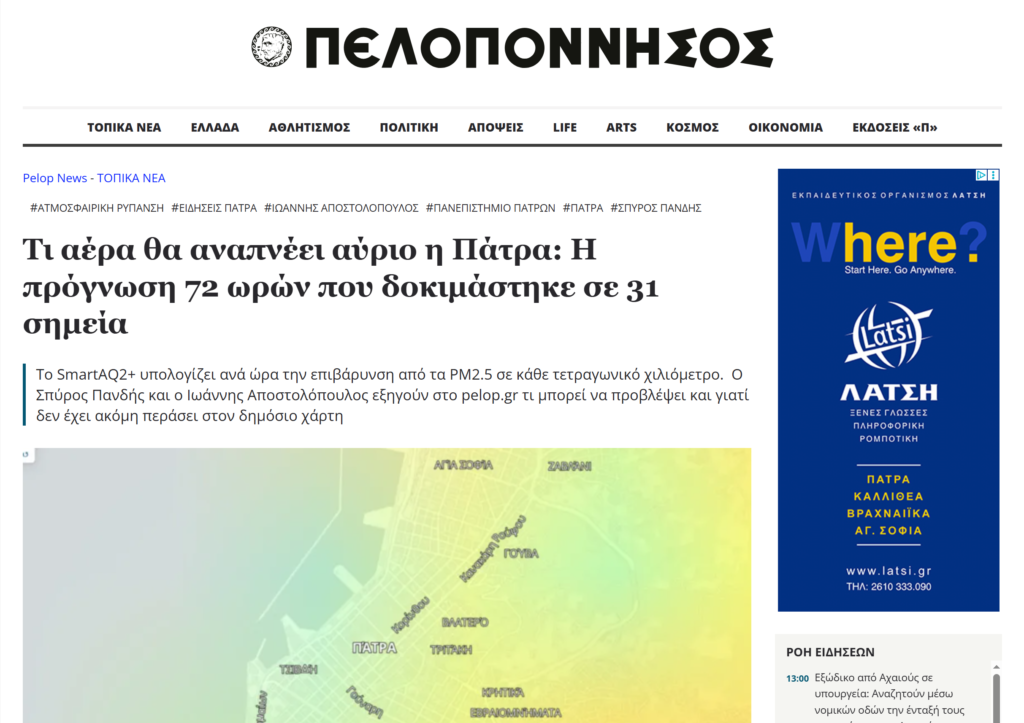
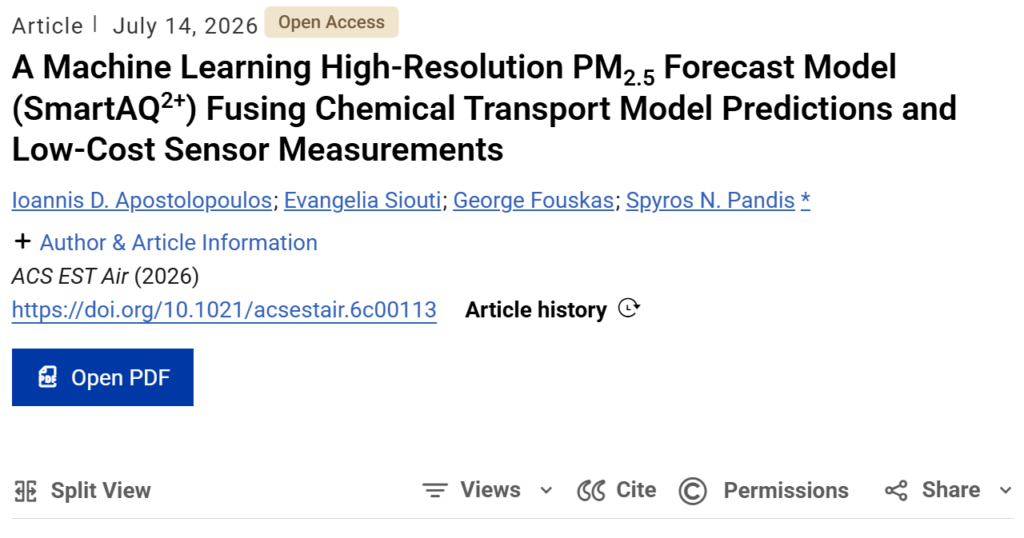
Τι αέρα θα αναπνέει αύριο η Πάτρα: Η πρόγνωση 72 ωρών που δοκιμάστηκε σε 31 σημεία Το SmartAQ2+ υπολογίζει ανά ώρα την επιβάρυνση από τα PM2.5 σε κάθε τετραγωνικό χιλιόμετρο.  Ο Σπύρος Πανδής και ο Ιωάννης Αποστολόπουλος εξηγούν στο pelop.gr τι μπορεί να προβλέψει και γιατί δεν έχει ακόμη περάσει στον δημόσιο χάρτη. Περισσότερα εδώ

Creations

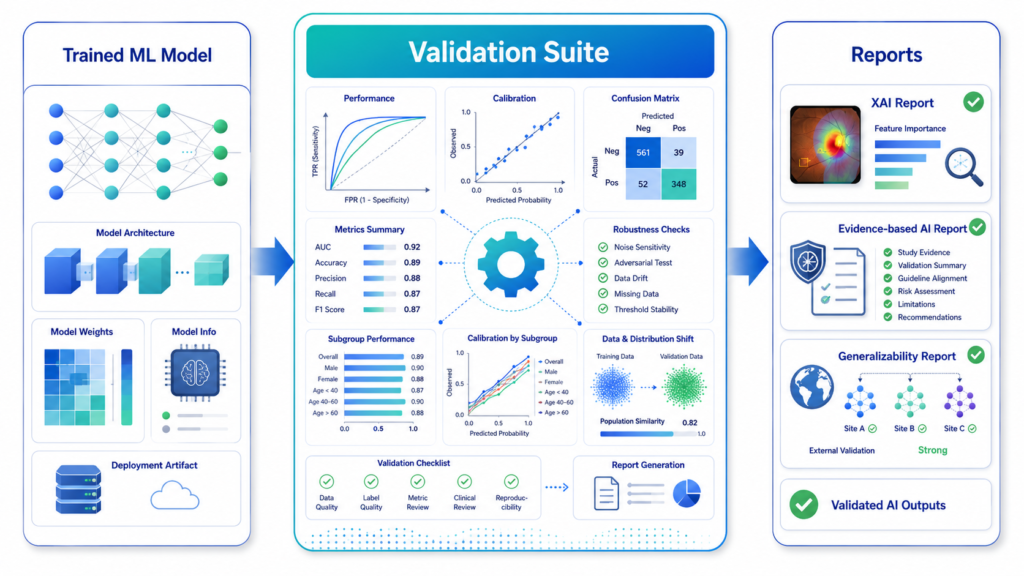
XAI Suite and Evidence-based AI validation tools

A cross-domain workbench for building, explaining and — critically — validating AI models before anyone trusts them. It couples model development with explainability outputs and an evidence-based assessment layer covering performance, calibration, uncertainty and reporting quality. Designed to be domain-agnostic: the same validation logic serves medical imaging, air quality, industrial and materials applications. The material presented on this page is credited to the teams and institutions within which it was developed. Unless explicitly stated otherwise, this entry documents my participation in the creation of the work and does not constitute a claim of ownership; intellectual property rights are generally held by the collaborating institutes, universities or funding organisations. For clarification regarding a specific creation, please contact me.

Creations

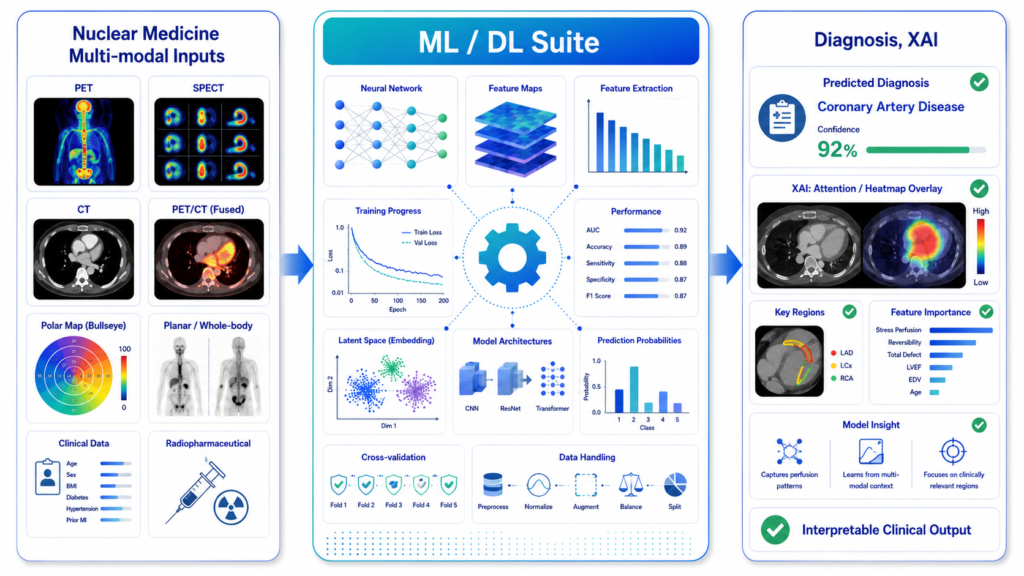
Explainable AI Suite for Nuclear Medicine

An end-to-end environment for developing and interrogating deep learning models on nuclear medicine and radiological images. It handles study import, model training and inference, and pairs every prediction with visual explanations, so that clinical users can see where the model looked rather than only what it decided. The material presented on this page is credited to the teams and institutions within which it was developed. Unless explicitly stated otherwise, this entry documents my participation in the creation of the work and does not constitute a claim of ownership; intellectual property rights are generally held by the collaborating institutes, universities or funding organisations. For clarification regarding a specific creation, please contact me.

Creations

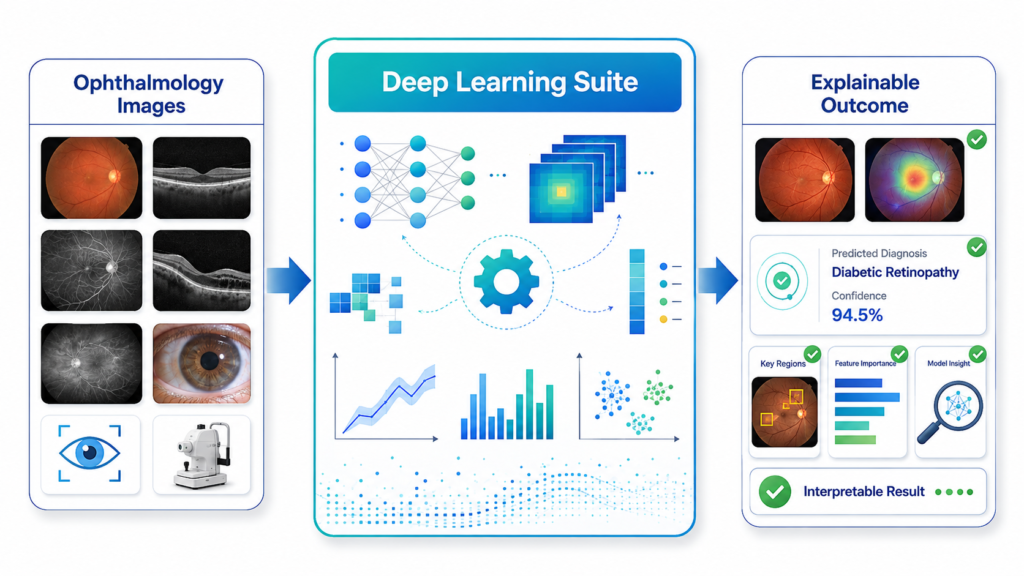
Explainable AI Suite for Ophthalmic disease screening

A screening-oriented version of the suite, adapted to ophthalmic imaging. It supports automated detection of ocular disease from retinal images, presents case-level explanation maps alongside each result, and is structured around the workflow of a screening programme rather than a single-case reading. The material presented on this page is credited to the teams and institutions within which it was developed. Unless explicitly stated otherwise, this entry documents my participation in the creation of the work and does not constitute a claim of ownership; intellectual property rights are generally held by the collaborating institutes, universities or funding organisations. For clarification regarding a specific creation, please contact me.

Creations

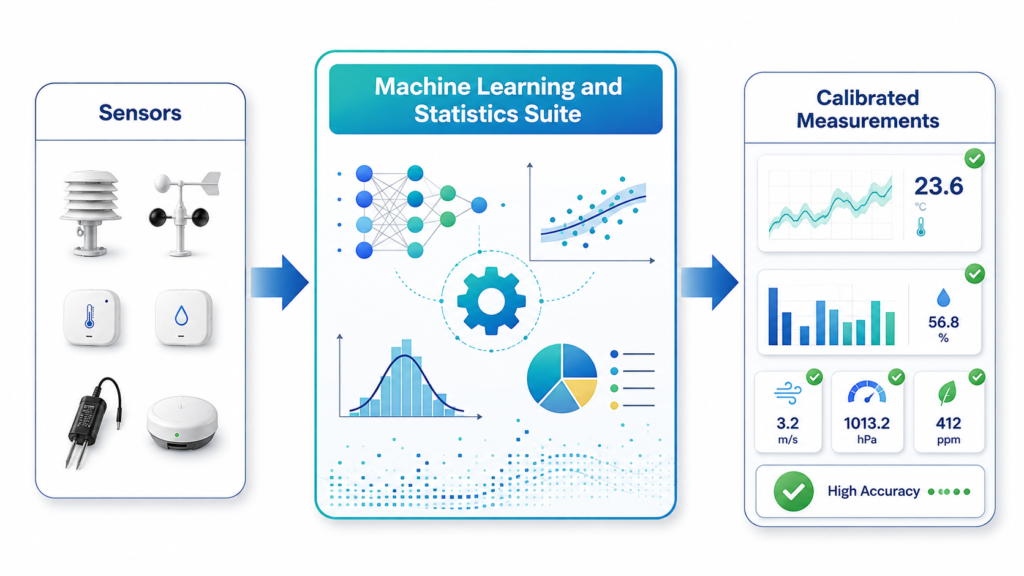
Air Quality Sensor AI-assisted Calibration Suite

A dedicated tool for turning raw low-cost sensor output into reference-comparable data. It ingests sensor and co-located reference measurements, applies machine-learning correction models on top of the manufacturer algorithms, and reports how much the correction actually improves agreement — making calibration a documented, repeatable step instead of an ad-hoc one. The material presented on this page is credited to the teams and institutions within which it was developed. Unless explicitly stated otherwise, this entry documents my participation in the creation of the work and does not constitute a claim of ownership; intellectual property rights are generally held by the collaborating institutes, universities or funding organisations. For clarification regarding a specific creation, please contact me.

Creations

Smart Air Quality 2xPlus

The current generation of the Smart Air Quality platform, extending measurement into forecasting. Alongside real-time monitoring, it produces short-term pollutant predictions from the network’s own history, so that users get not only the present state of the air but a usable outlook on the hours ahead. The material presented on this page is credited to the teams and institutions within which it was developed. Unless explicitly stated otherwise, this entry documents my participation in the creation of the work and does not constitute a claim of ownership; intellectual property rights are generally held by the collaborating institutes, universities or funding organisations. For clarification regarding a specific creation, please contact me.

Scroll to Top
Name
My interests
I will use any given material for educational non-profit purposes